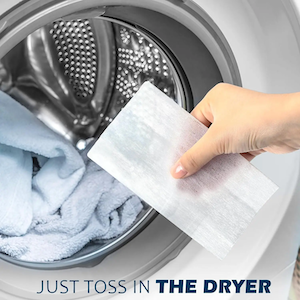
Let’s call it what it is. A dryer sheet is a scrap of polyester soaked in wax and quaternary ammonium compounds — industrial softening agents — plus a fragrance blend nobody’s required to disclose. Your dryer’s heat melts that coating and smears it directly onto the fabric touching your skin. That’s it. That’s the whole product.
The static “disappears” because your clothes are now wearing a thin layer of grease. Congratulations, you’ve been sold a wax job.
Here’s what that wax job costs you:
Your towels stop working. Absorbency is the entire point of a towel. Wax repels water. Every dryer sheet cycle lays down a little more film, and every cycle your towels get a little worse at the one thing they exist to do. If your “good” towels have quietly turned into water-pushers instead of water-soakers, this is why.
Your workout gear stops breathing. Moisture-wicking fabric is engineered to pull sweat off your skin and through the weave. Coat that weave in softener residue and you’ve built a tiny greenhouse for sweat and bacteria to sit in. You paid extra for technical fabric and then paid again to sabotage it.
It’s building up inside your dryer, too. Run water over your lint screen. If it beads up instead of soaking in, that’s residue — the same film, just relocated. A coated screen chokes airflow, which means longer dry times, higher energy bills, and yes, a bump in fire risk from restricted ventilation.
And then there’s the fragrance nobody has to explain. Manufacturers are not legally required to tell you what’s in “fragrance” — it’s treated as a trade secret. University of Washington researchers actually bothered to test what comes out the other end: they sampled dryer vent exhaust and found around 25 volatile organic compounds when a scented detergent and scented dryer sheet were used together, seven of them classified by the EPA as hazardous air pollutants — including benzene and acetaldehyde, both carcinogens with no recognized safe exposure level. And unlike a car exhaust or a factory smokestack, dryer vent emissions aren’t regulated or monitored at all. Nobody’s checking what’s drifting out of your laundry room.
To be fair, the researchers tested detergent and dryer sheets together and couldn’t fully separate which product was responsible for which chemical — so this isn’t an airtight “dryer sheets specifically cause cancer” finding. But it doesn’t need to be airtight to make the point: you have no idea what’s in that fragrance, nobody’s required to tell you, and nobody’s watching what happens when it gets heated and aerosolized in your house.
Skip it entirely:
- Wool or hemp dryer balls. About $15, lasts for years, no coating, no mystery fragrance, and it cuts drying time instead of extending it.
- Nothing. Most static is just a symptom of overdrying. Pull your laundry while it’s slightly damp and the static problem mostly solves itself — for free.
You don’t need the wax. You don’t need the mystery chemicals. You definitely don’t need to pay for something that makes your towels and your gym clothes worse over time.
Dryer sheets are a bullshit waste of money, and they're actually ruining your stuff.
— Give A Shit About Nature (@giveashitnature) September 17, 2026
Here's how they work. The sheet is non-woven polyester coated in a waxy softener, usually quaternary ammonium compounds, plus fragrance. Yum.
Heat melts the coating off and it transfers onto… pic.twitter.com/M7IXBoG5Ws